Use daytime solar after sunset
When your panels produce more than your home uses, a battery can store the surplus. That energy can help power dinner, lights and air conditioning later in the day.
Compare savings with and without a battery Contact
At home, store spare solar for the evening or plan backup for essential appliances. At work, start with your electricity bill and production schedule to see where a battery could earn its keep.
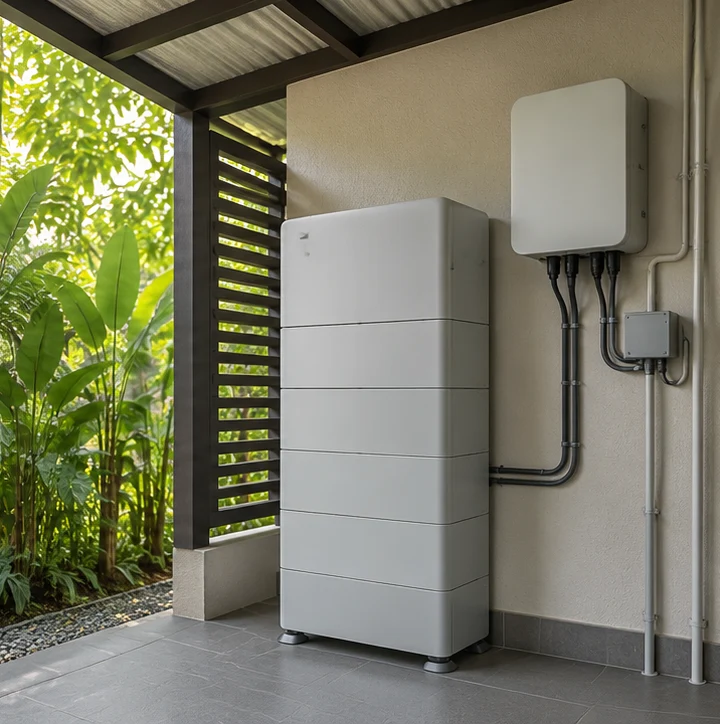
When your panels produce more than your home uses, a battery can store the surplus. That energy can help power dinner, lights and air conditioning later in the day.
Compare savings with and without a batteryWith backup configured, a battery can keep selected circuits running during a power cut. A fridge, lights and Wi-Fi will usually run longer on the same charge than an air conditioner.
Estimate my backup energy needsIf you already have solar panels, you may be able to keep them. Some inverters can connect to a compatible battery directly. Other systems can use a separate battery inverter.
Discuss adding a battery to my solar systemStart with a recent electricity bill and your operating hours. Your load profile shows how electricity demand changes throughout the day, including when peaks occur and how long they last.
We review the tariff, billed demand and load profile. A brief demand spike and a long production peak can require very different storage capacity.
Explore a peak shaving exampleWhere daytime generation exceeds demand, a battery can carry surplus power into a later shift. If production already uses all the solar as it is generated, there is no surplus to store.
Compare solar alone with solar plus storageIdentify priority circuits, starting loads, acceptable interruption time and the operating window. Our team uses these to scope a technical review.
For a process line that needs a controlled shutdown, identify which controls must stay live and for how long. Backup requires a suitable switching arrangement and enough energy held in reserve.
Discuss my critical equipmentChoose how many appliances you want to run together and for how long. The watts shown are examples. Use your measured average power if available. Fridges and inverter air conditioners cycle, so their draw varies.
For reference only.It can if your system has automatic backup switching. Only the circuits connected for backup will receive power. Before installation, confirm whether your fridge, lights and Wi-Fi are on those circuits and whether they may briefly switch off.
Yes, if the panels and inverter are configured to operate in backup mode. Solar first has to cover the appliances running at the time. Any remaining generation can recharge the battery, so sunny weather alone does not guarantee a recharge.
Many systems let you set a backup reserve. During normal use, the battery stops discharging at that level, leaving stored energy for an outage. A higher reserve leaves less energy for routine evening use.
Yes, when daytime generation exceeds what the site is using. A battery can store that surplus for later. If production uses all the solar as it is generated, there is no spare solar to carry into the night shift.
If your tariff includes a maximum demand charge, a battery can discharge when several large loads run together. It helps only if that discharge lowers the peak recorded for billing. Your load profile shows when those peaks occur and whether another peak later in the month could set the charge.
A battery can store surplus solar or manage demand while the grid is available. During an outage, a UPS can bridge an interruption for sensitive equipment and a generator can support a longer outage. Using a battery alongside them requires compatible controls and a tested changeover sequence.